

alesis sr 16 instruction manual
Alesis SR-16: A Comprehensive Guide (Based on Available Information ⎻ 04/01/2026)
This guide unlocks the SR-16’s potential! It details features, functions, and operating instructions, helping you maximize your experience with this drum machine.
Welcome to the world of rhythmic possibilities! The Alesis SR-16 is a renowned, versatile drum machine celebrated for its robust sound engine and intuitive workflow. This guide serves as your companion, unlocking the full potential of this iconic instrument.
Whether you’re a seasoned producer, a budding beatmaker, or a live performer, the SR-16 offers a powerful toolkit for crafting compelling drum tracks. This manual explores its features, functionalities, and provides essential operating instructions, ensuring a smooth and inspiring creative journey. Prepare to dive in and discover the SR-16’s capabilities!
What’s in the Box?
Upon opening your Alesis SR-16 package, you should find several key components. These include the SR-16 drum machine itself, a power adapter to ensure reliable operation, and this comprehensive instruction manual to guide you through setup and usage.
Additionally, you may receive a MIDI cable for connecting to other musical equipment, allowing for seamless integration with your existing setup. Carefully inspect all items to confirm everything is present and undamaged. Retain the original packaging for potential future transport or warranty claims.
Understanding the SR-16’s Control Panel
The SR-16’s control panel is intuitively designed for efficient beat creation. It features a prominent LCD display providing visual feedback on settings and patterns. Dedicated buttons allow for quick access to essential functions like pattern selection, tempo adjustment, and sound editing.
The step-sequencer pads are central to programming rhythms, while knobs offer precise control over parameters like volume, pan, and effects. Familiarizing yourself with these elements is crucial for unlocking the SR-16’s full creative potential.
Powering On and Initial Setup
To begin, connect the SR-16 to a suitable power source using the provided adapter. Ensure the power switch, located on the rear panel, is in the ‘off’ position before connecting. Once connected, flip the power switch to ‘on’. The LCD display will illuminate, initiating a self-test.
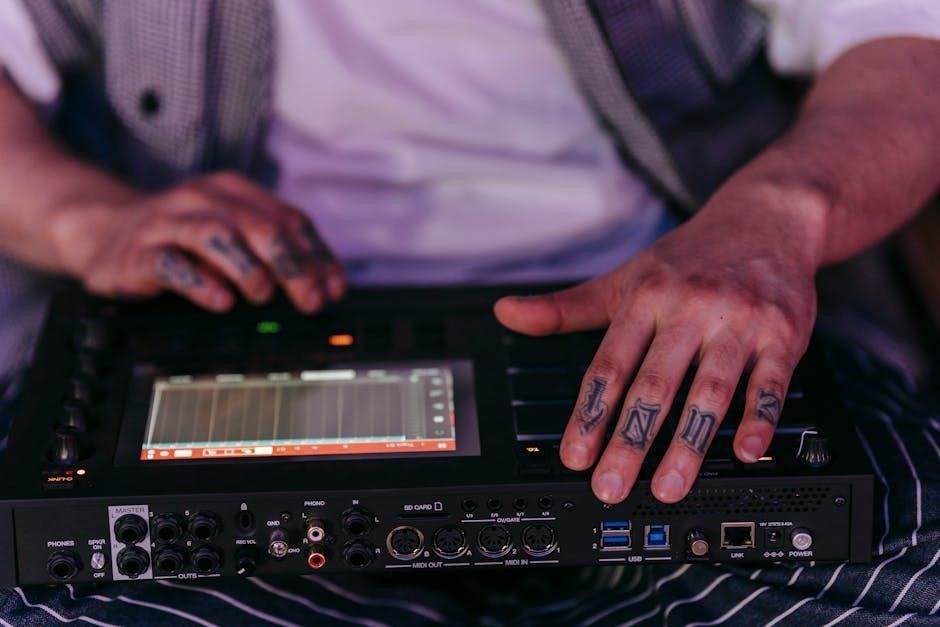
Upon startup, the SR-16 defaults to a pre-loaded pattern. Verify audio output by connecting to speakers or headphones. Initial setup involves setting the master volume and confirming MIDI synchronization preferences, if applicable.
Display Overview & Navigation
The SR-16’s LCD display presents crucial information: pattern number, tempo, time signature, and selected drum kit. Navigation relies on the dedicated buttons surrounding the display – ‘Pattern’, ‘Tempo’, ‘Write’, and ‘Play/Stop’. Use these buttons to cycle through options and access editing functions.
The ‘Value’ dial fine-tunes parameters. Pressing ‘Write’ enters edit mode, while ‘Pattern’ selects different patterns. Familiarize yourself with these controls for efficient operation and seamless pattern exploration.
Basic Operation: Creating a Simple Beat
Initiating a beat is straightforward! Begin by powering on the SR-16 and selecting a desired pattern number. Press ‘Write’ to enter programming mode. Now, tap the instrument buttons – bass drum, snare, hi-hat – corresponding to the desired rhythm. Each press creates a step in the pattern.
Utilize the ‘Play/Stop’ button to audition your creation. Adjust the tempo using the ‘Tempo’ dial for desired speed. Experiment with different instrument combinations to build a foundational beat.
Selecting a Drum Kit
Choosing the right kit is crucial! Press the ‘Kit’ button to access the drum kit selection menu. Use the up/down arrow buttons to scroll through the available kits, listening to each one via the ‘Play’ button. The SR-16 offers a diverse range of pre-programmed kits, spanning various genres – rock, pop, electronic, and more.
Once you’ve found a suitable kit, press ‘Write’ to confirm your selection. Remember, kits can be further customized later, allowing for personalized sound design. Explore each kit thoroughly!
Programming a Basic Pattern
Let’s create your first beat! After selecting a kit, press ‘Pattern’ to enter pattern programming mode; Choose a pattern number using the number pad. Now, tap the instrument pads to input notes – the SR-16 visually represents these on the display grid. Adjust the tempo using the ‘Tempo’ knob for desired speed.
Experiment with different rhythms and instrument combinations. Press ‘Play’ to audition your pattern. Use ‘Write’ to save your creation. Simple, right?
Advanced Programming Techniques
Elevate your beats beyond the basics! The SR-16 offers powerful tools for nuanced rhythm creation. Explore detailed step sequencing, allowing precise control over each note’s timing and placement. Master velocity and accent control to inject dynamic expression into your patterns, making them truly breathe.
Don’t forget swing and shuffle implementation – these features add a human feel. Experiment with these techniques to unlock a world of rhythmic possibilities and create complex, captivating grooves.
Step Sequencing in Detail
Dive deep into the heart of SR-16 programming! Step sequencing allows meticulous control, placing each hit precisely within the pattern grid. Utilize the intuitive interface to input notes, rests, and accents on each step. Experiment with different time divisions – 16th, 8th, and quarter notes – to craft intricate rhythms.
Remember, each step represents a specific moment in time. Mastering this granular control unlocks the SR-16’s full potential for complex and expressive beat creation.
Velocity and Accent Control
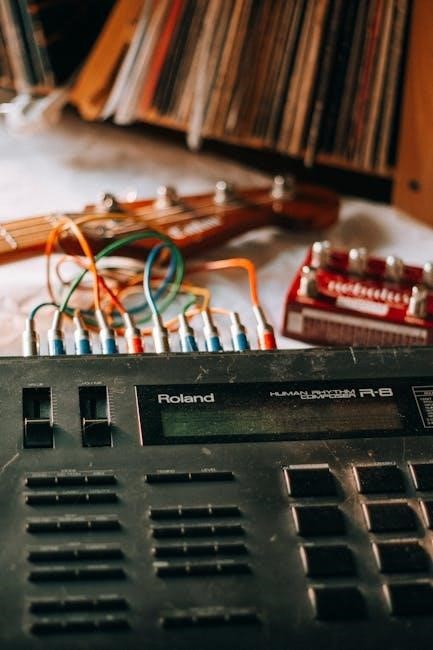
Bring your beats to life with dynamic expression! The SR-16 allows precise control over the volume of each hit using velocity settings. Assign different velocity values to individual steps, creating subtle nuances or dramatic impacts. Accent control further enhances this, allowing you to emphasize specific beats within a pattern.
Experiment with varying velocities and accents to inject human feel and groove into your programmed rhythms, moving beyond robotic precision.
Swing and Shuffle Implementation
Infuse your rhythms with groove and feel! The SR-16 offers dedicated swing and shuffle controls to move beyond rigid timing. Adjust the swing percentage to subtly delay every other beat, creating a relaxed, natural feel. Shuffle provides a similar effect, but with a more pronounced rhythmic displacement.
Experiment with these parameters to achieve various styles, from subtle jazz grooves to driving funk beats; Fine-tune the settings to perfectly match your musical vision.
Memory Management & Saving Patterns
Preserve your creations! The SR-16 allows you to store and recall custom patterns and drum kits. Efficient memory management is crucial for organizing your sounds. Utilize the internal memory to save frequently used patterns, ensuring quick access during performance or songwriting.
Properly naming patterns aids in easy identification. Regularly back up your work to avoid data loss. Explore the loading and recall functions to seamlessly integrate saved patterns into your musical arrangements.
Saving Patterns to Internal Memory
Secure your rhythmic ideas! To save a pattern, first ensure it’s fully programmed and sounding as desired. Access the ‘Write’ function, typically via a dedicated button or menu option. The SR-16 will prompt you to select a memory location – choose an empty slot or overwrite an existing one.
Give your pattern a descriptive name for easy recall. Confirm the save operation, and the pattern is now safely stored in the SR-16’s internal memory, ready for future use or song creation.
Loading and Recalling Patterns
Bring your saved rhythms back to life! To load a pattern, navigate to the ‘Read’ or ‘Recall’ function, usually accessible through a menu or dedicated button. The SR-16 will present a list of stored patterns. Select the desired pattern by its name or number.
Once selected, the pattern will load into the active memory, immediately ready for playback or further editing. This allows quick access to previously created beats, streamlining your workflow and inspiring new musical ideas.
Using the SR-16 with External Devices
Expand your sonic palette! The SR-16 boasts robust MIDI implementation, enabling seamless connection with synthesizers, computers, and other MIDI-compatible instruments. Utilize standard MIDI cables to transmit and receive note data, control changes, and synchronization signals.
This connectivity unlocks powerful possibilities for layering sounds, controlling the SR-16 from a DAW, or synchronizing it with other hardware. Explore the SR-16’s MIDI settings to configure channels and parameters for optimal integration.
MIDI Implementation & Connections
Unlock external control! The SR-16 utilizes standard 5-pin DIN MIDI connectors for both input and output. Connect the MIDI OUT of the SR-16 to the MIDI IN of your external device, and vice-versa for receiving MIDI data.
Configure the SR-16’s MIDI channel to match your external device. Experiment with transmitting and receiving note data, program changes, and control messages. Proper MIDI setup allows for complex arrangements and real-time performance control, expanding the SR-16’s capabilities.
Syncing with Other Instruments
Achieve rhythmic precision! The SR-16 can synchronize to external devices via MIDI clock. Access the SR-16’s global settings to select “MIDI” as the clock source, enabling it to follow the tempo of another instrument. Alternatively, the SR-16 can send MIDI clock to control the tempo of connected devices.
Ensure both devices are set to the same MIDI channel for seamless synchronization. Experiment with different sync modes for varied rhythmic interactions, creating a cohesive and tightly-timed musical performance.

Editing Existing Patterns
Refine your creations! The SR-16 allows extensive editing of pre-made and user-created patterns. Access the pattern edit mode to modify individual steps, adjust velocities, and alter note placements. Utilize the copy and paste functions to duplicate rhythmic ideas within a pattern or across multiple patterns.
Explore pattern chaining to seamlessly link patterns together, forming extended song arrangements. Song mode enables you to arrange these chained patterns into a complete musical composition, offering dynamic control over your performance.
Copying and Pasting Sections
Streamline your workflow! The SR-16’s copy and paste functions are invaluable for efficient pattern editing. Select a specific section of a pattern – a measure, a beat, or even individual steps – and copy it to the clipboard. Then, paste this section into the same pattern or a completely different one.
This feature accelerates repetitive tasks, allowing for quick variations and the development of complex rhythmic structures. Experiment with pasting sections to create interesting fills and transitions within your compositions.
Pattern Chaining & Song Mode
Build complete arrangements! Pattern chaining allows you to link multiple patterns together, creating a sequence that plays continuously. This is the foundation of Song Mode, where you can arrange these chained patterns into a full song structure. Define the order and number of repetitions for each pattern.
Song Mode provides a non-destructive way to experiment with arrangements, easily modifying the sequence without altering the individual patterns themselves. This feature unlocks the SR-16’s potential for live performance and composition.
Understanding Drum Kit Editing
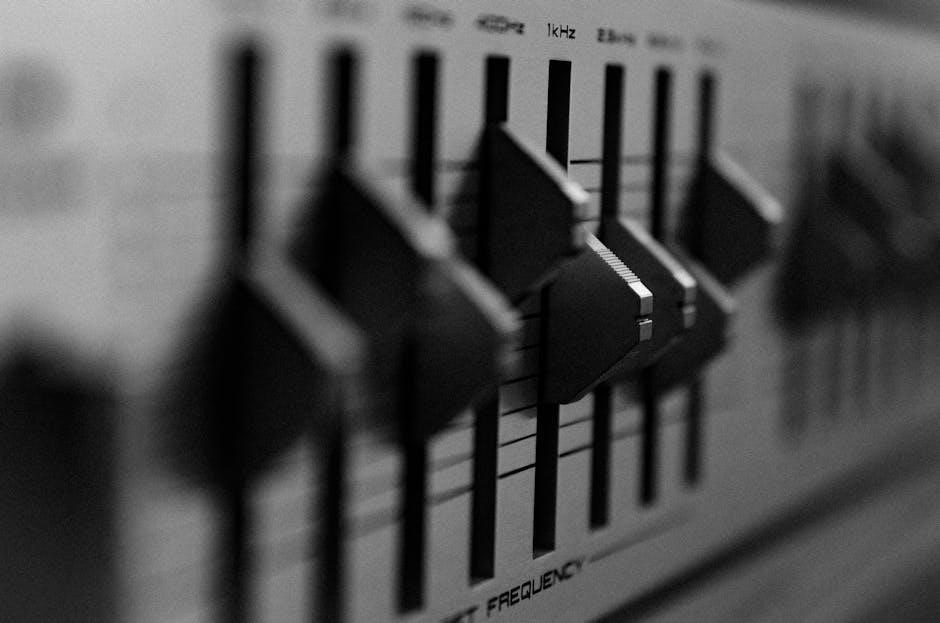
Shape your sound! The SR-16 allows deep editing of individual drum sounds within each kit. Adjust parameters like pitch, decay, and level to sculpt unique tones. Explore the kit editing functions to create entirely new sounds or modify existing ones to fit your musical vision.
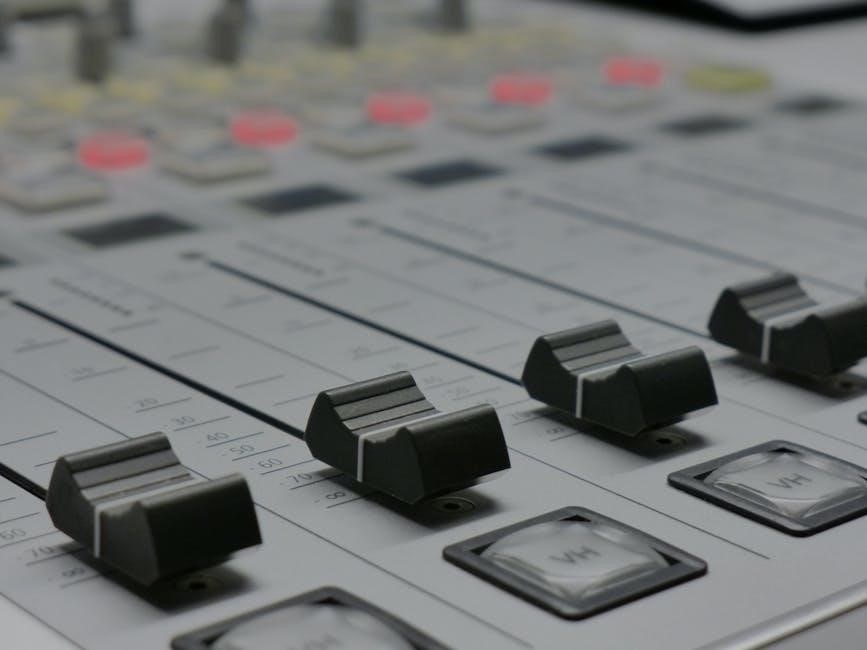
Kit creation is intuitive; save your custom kits for instant recall. Modification options are extensive, offering precise control over each instrument’s character. This empowers you to move beyond presets and craft truly personalized drum kits.
Individual Sound Editing
Dive deep into sonic detail! Each drum sound within a kit can be individually edited on the SR-16. Parameters like pitch, level, pan, and decay time are readily accessible. Fine-tune each instrument to achieve the perfect blend and sonic texture for your tracks.
Experiment with these controls to drastically alter the character of each sound. Adjusting decay creates shorter or longer notes, while pitch shifting adds unique tonal qualities. Precise control unlocks a world of sonic possibilities within each kit.
Kit Creation and Modification
Unleash your creativity! The SR-16 allows for complete kit creation and modification. Start from a pre-existing kit or build one from scratch using the diverse sound library. Easily replace individual sounds with others, tailoring the kit to your specific musical needs.
Save your custom creations to internal memory for instant recall. Experiment with layering sounds and adjusting levels to craft unique and inspiring drum kits. The SR-16 empowers you to design the perfect sonic palette for any genre.
Utilizing the SR-16’s Effects
Enhance your sounds! The SR-16 features built-in effects to add depth and character to your drum patterns. Explore reverb for spaciousness, delay for rhythmic echoes, and chorus for a lush, swirling texture.
Experiment with modulation effects to create unique sonic landscapes. Adjust effect parameters to fine-tune the sound to your liking. These effects can dramatically transform your drum kits, adding a professional polish and inspiring new creative possibilities.
Reverb and Delay Settings
Sculpt spaciousness and depth! The SR-16’s reverb controls adjust decay time, creating environments from subtle rooms to expansive halls. Experiment with pre-delay for a more natural sound. Delay offers rhythmic echoes; adjust time, feedback, and mix for varied effects.
Short delays create slapback, while longer times generate repeating patterns. Careful adjustment of these parameters is key to achieving professional-sounding drum tracks. Combine reverb and delay for complex, layered textures, enhancing the overall sonic impact.
Chorus and Other Modulation Effects
Add richness and movement! The SR-16’s chorus effect thickens sounds, creating a lush, ensemble-like quality. Adjust depth and rate for subtle widening or dramatic swirling. Explore other modulation options like flanger and phaser for unique textures.
These effects introduce subtle pitch variations, adding character and interest. Experiment with different settings to find the perfect complement to your drum kits and patterns. Modulation effects can breathe life into static sounds, enhancing their dynamic range.
Troubleshooting Common Issues
Facing problems? Let’s resolve them! If you encounter “No Sound Output,” verify connections, volume levels, and ensure a kit is selected. For “MIDI Connectivity Problems,” check cable integrity, MIDI settings on both devices, and system exclusivity settings.
Ensure proper channel assignment and that the SR-16 is transmitting/receiving on the correct MIDI channel. A power cycle of both devices can often resolve communication errors. Consult the manual for detailed troubleshooting steps and contact Alesis support if issues persist.
No Sound Output
Silence when you expect sound? First, meticulously check all cable connections – audio outputs to your mixer or amplifier, and power connections. Verify the master volume and individual track volumes are not muted or set too low. Confirm a drum kit is selected within the SR-16’s programming;
Also, ensure your external amplifier or interface is powered on and set to the correct input channel. A headphone test can isolate whether the issue is with the SR-16 itself or the external audio path.

MIDI Connectivity Problems
Experiencing MIDI communication failures? Double-check the MIDI cable connections between the SR-16 and your controlling device (computer, keyboard, etc.). Ensure the correct MIDI input/output ports are selected on both devices. Verify the SR-16’s MIDI settings – channel, transmit/receive status – align with your setup.
Try a different MIDI cable to rule out a faulty connection. Software conflicts on your computer can also interfere; close unnecessary programs and restart your system.
Firmware Updates & Resources
Keep your SR-16 operating optimally! Regularly check the official Alesis Support website for available firmware updates. These updates often include bug fixes, performance enhancements, and potentially new features. Download the latest firmware and carefully follow the provided instructions for installation – typically involving a MIDI connection and dedicated software.
The Alesis website is also a valuable resource for additional documentation, FAQs, and troubleshooting guides. Don’t hesitate to explore their support section for assistance;
Checking for Updates
Ensure peak performance by staying current! Visit the official Alesis Support website frequently to determine if new firmware updates are available for your SR-16. Look for a dedicated “Downloads” or “Support” section, specifically for the SR-16 model.
Alesis typically lists the latest firmware version number and a detailed changelog outlining improvements. Regularly checking allows you to benefit from bug fixes, enhanced stability, and potential new functionalities added through these updates.
Alesis Support Website
Your primary resource for assistance is the Alesis Support website! This online hub provides a wealth of information, including frequently asked questions (FAQs), troubleshooting guides, and downloadable resources like the SR-16’s official instruction manual.
You can also submit support requests directly to the Alesis customer service team through the website. Expect detailed answers and assistance with any operational issues or questions regarding your SR-16 drum machine.
SR-16 Specifications
Understanding the SR-16’s technical details is crucial for optimal use. This section outlines key specifications, ensuring compatibility with your setup and a clear understanding of its capabilities. Detailed information regarding power requirements, input/output connections, and MIDI implementation are provided.
These specifications are vital for integrating the SR-16 with other instruments and digital audio workstations (DAWs), maximizing its potential within your musical workflow. Refer to these details for informed decisions.
Technical Specifications Overview
The Alesis SR-16 boasts 128 programable drum patterns and 32 editable drum kits. It features 16-voice polyphony, offering rich and complex sound layering. MIDI In/Out ports enable seamless synchronization and control with external devices, expanding creative possibilities.
The SR-16 operates on 6 D batteries or a 9V DC adapter (center negative). Its dimensions are approximately 12.25″ x 8.5″ x 2.75″, and it weighs around 4.4 lbs, making it portable for live performances and studio sessions.
Power Requirements
The Alesis SR-16 offers flexible power options for diverse usage scenarios. It can be efficiently powered by six D-size alkaline batteries, providing portability for on-the-go music creation and performance. Alternatively, a 9V DC adapter with a center-negative plug is recommended for sustained studio use.
Ensure the adapter’s output voltage matches the SR-16’s requirement to prevent damage. Battery life varies depending on usage, and an optional AC adapter is highly suggested for prolonged sessions.
Exploring Creative Applications
The SR-16 transcends basic beat-making, offering diverse creative avenues. For live performances, its compact size and robust build make it ideal for triggering patterns and layering sounds. Seamlessly integrate the SR-16 into your Digital Audio Workstation (DAW) via MIDI, utilizing it as a controller or sound source.
Experiment with sequencing external instruments, crafting unique arrangements, and building complex compositions. The SR-16’s versatility empowers musicians to explore endless sonic possibilities.
Using the SR-16 for Live Performance
The Alesis SR-16 excels in live settings due to its reliability and compact form factor. Utilize its pattern chaining and song mode to create dynamic sets, transitioning seamlessly between different sections. Trigger patterns manually or via MIDI foot controllers for hands-free operation.
Experiment with real-time pattern variations and fills to keep performances engaging. The SR-16’s robust build ensures it can withstand the rigors of the road, making it a dependable companion for any musician.

Integrating with Digital Audio Workstations (DAWs)
The SR-16 seamlessly integrates with DAWs via MIDI, functioning as a controller or sound source. Record patterns directly into your DAW as MIDI data for further editing and manipulation. Alternatively, use the SR-16 to trigger virtual instruments within your DAW environment.
Sample the SR-16’s sounds for unique textures and incorporate them into your productions. MIDI clock synchronization ensures tight timing between the SR-16 and your DAW, streamlining your workflow.
SR-16 vs. Other Drum Machines
The Alesis SR-16 distinguishes itself with its intuitive interface and robust sound library, offering a balance between simplicity and power. Compared to more complex machines, the SR-16 excels in ease of use, making it ideal for beginners and experienced users alike.
While lacking the extensive features of some competitors, its focused design delivers exceptional rhythmic foundations. It provides a cost-effective solution for reliable drum programming and live performance capabilities.
Comparison with Competitors
Compared to Roland TR-808 or TR-909, the SR-16 offers a different sonic palette, leaning towards sampled acoustic and electronic drums rather than purely synthesized sounds. It’s more affordable than these iconic machines, providing a practical alternative for budget-conscious musicians.
Against Akai MPCs, the SR-16 prioritizes streamlined drum programming over extensive sampling and sequencing capabilities. It’s a dedicated drum machine, excelling in rhythmic creation without the complexities of a full workstation.

Maintaining Your SR-16
To ensure longevity, regularly clean the SR-16 with a soft, dry cloth. Avoid liquids, especially near the control panel and connections. Store it in a cool, dry place, away from direct sunlight and extreme temperatures.
Periodically check the power adapter and cables for damage. Dust accumulation inside the unit should be addressed cautiously; consider professional cleaning if you’re uncomfortable opening the device. Proper care preserves its functionality for years!
Cleaning and Storage
Regular cleaning extends the SR-16’s lifespan. Use a soft, dry cloth to wipe down the exterior, avoiding abrasive cleaners or liquids. Pay attention to the control panel and buttons, removing any dust or debris.

For storage, choose a cool, dry environment, shielded from direct sunlight and extreme temperatures. A protective case is recommended during transport. Disconnect the power adapter when not in use, and ensure cables are neatly organized to prevent damage.